
First steps in habitat restoration for ‘Spring Creek Pasture’




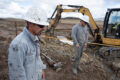
The 350-acre “Spring Creek Pasture” has been home to the Tribe’s bison herd since the early 2000s. Over that time the herd numbers have fluctuated, but generally the carrying capacity of the pasture is about 100 bison, and that is where the Southern Ute Indian Tribe’s Wildlife Resource Division likes to keep herd numbers today.
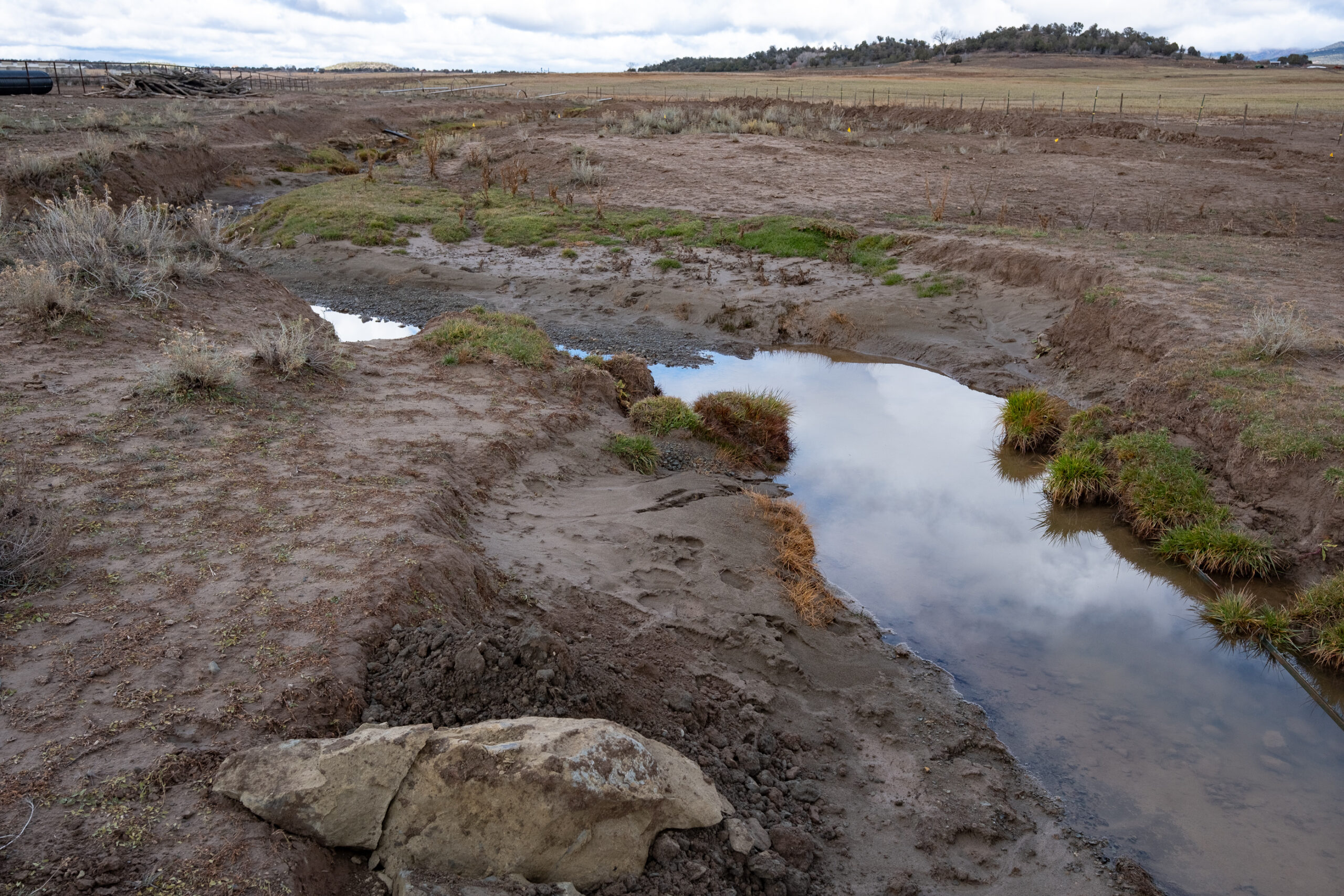
Salabar Draw is a small perennial stream that bisects the pasture. “The northern portion of the stream has been open to unrestricted grazing by the herd since animals were introduced,” said Aran Johnson, Southern Ute Wildlife Resource Division Head. “The southern portion of the stream has had varying levels of fencing to restrict bison access, but wire fencing is not particularly effective if bison want what is on the other side, so there were frequent ‘break-ins.’”
In 2015, through survey work, the Wildlife Division learned that the southern, more protected portion, of Salabar Draw is home to an endangered species, the New Mexico Meadow Jumping Mouse, a unique mouse that is tied to healthy riparian ecosystems in Colorado, New Mexico, and Arizona. As the bison herd grew larger, the animals began break through the wire fencing more frequently and to impact the southern part of the stream, so the Wildlife Division secured grant funding to protect the southern portion of Salabar Draw with pipe fencing that ensured protection of a healthy watershed and habitat for wildlife, including endangered species that rely on the stream. At that time the northern portion of Salabar Draw was still open to unrestricted access by the bison for watering.
“In 2025, the Environmental Programs Division (EPD) approached us and asked about our needs on the bison pasture; how could they assist us with promoting and restoring the watershed on Salabar Draw?” Johnson said. “They had grant funds that they were willing to use on the bison pasture if we could put our heads together on good projects. We ultimately decided on several projects that were separate … but all related to water quality on Salabar Draw.”
Pipe exclusion fencing has now been installed on the entire northern position of the stream, but with two separate low water crossings that allow bison access to specific watering points, without allowing access to the rest of the habitat. Time and targeted habitat restoration techniques will ultimately allow the habitat along that portion of the stream to recover and be effective for all the wildlife species that use riparian habitats, including the endangered jumping mouse.
“EPD appreciates the opportunity to collaborate with the Wildlife Division to improve habitat for the bison herd,” Environmental Programs Director, Mark Hutson said. “A project of this magnitude enhances tribal resources and improves communication between Tribal Departments.”
The Tribe’s Environmental Programs Department also funded a new heavy equipment crossing with culverts that will allow the Bison Program more secure access across the stream. “Prior to this work, there were two small culverts with a road crossing that were marginally effective for getting our tractor and haying equipment across the stream,” Johnson said. “These culverts would periodically overtop when the stream was subject to high storm flows. With the improved crossing there are now three large culverts that have been set with concrete into the bedrock on the stream that will allow for easy crossing with our biggest equipment needs and will easily handle the largest storm flows that come down Salabar Draw.”
“In addition to the low water crossings on the northern section of the stream, EPD also worked with us to push a small dirt tank/pond southeast of our hay barn, which will allow bison to water off the stream during the irrigation season, which will be a great option for the herd.”
The Wildlife Division has also been working with EPD on plans for a stream restoration project on the southern portion of Salabar Draw for the coming year. According to Johnson, the project will essentially mimic the work that beavers do with small brush dams along the stream that will back up water to raise the wet zone of the stream and promote riparian plants like willow as well as other grasses and forbs to grow and secure the stream banks. Other structures will divert the energy of the stream flows away from eroding banks.
“The 319 Program works to reduce nonpoint source (NPS) pollution that enters tribal waters,” said Water Quality Scientist, Dylan Ruckel. “NPS Pollution generally results from land runoff, precipitation, drainage, and other dispersed sources. It is reported that NPS pollution is the leading cause of water quality issues across the nation. The 319 Program was searching for projects that promoted collaboration between Tribal Divisions and could achieve multiple important goals. These projects at the bison pasture continue to invest into an important environmental and cultural resource.”
“The exclusion fencing along Salabar Draw is designed to protect sensitive riparian vegetation by limiting bison access to the stream,” Ruckel said. “By reducing grazing and soil compaction on streambanks, plants will have the opportunity to recover and strengthen the banks. Healthier vegetation provides important food and shelter for both wildlife and aquatic species, and plant material that enters the stream will help support the in-stream ecosystem. In the future, once vegetation is well established inside the fenced areas, limited rotational grazing may be reintroduced to maintain a healthy balance between plants and grazing animals.”
“The Wildlife Division is grateful that EPD reached out to us on these great projects that are promoting a healthy watershed on the bison pasture,” Johnson said. “These projects are benefitting the bison, and by extension the tribal membership that recognize the herd as an important source of spiritual power and healing as well as a source of healthy protein through our bison meat distribution program. We look forward to continuing to work with EPD on future projects as well.”
Funding for the project is primarily from the Environmental Protection Agency, the program is also receiving support from private, non-governmental funding sources such as The Nature Conservancy and First Nations Development Institute. Construction and general labor is contracted through Alpine Enterprise and stream restoration through EcoWorks LLC.
Planned completion of road improvements, exclusion fencing and bison crossings are set for later this winter. The in-stream restoration work is set to take place over the course of the next five years, from 2026-2031.
“EPD is thrilled to partner with Tribal Departments such as the Wildlife Resource Management Division, the U.S. Environmental Protection Agency, and The Nature Conservancy to improve the Tribe’s water quality and enhance its wildlife,” said Water Quality Program Manager, Geoff Hensgen.