
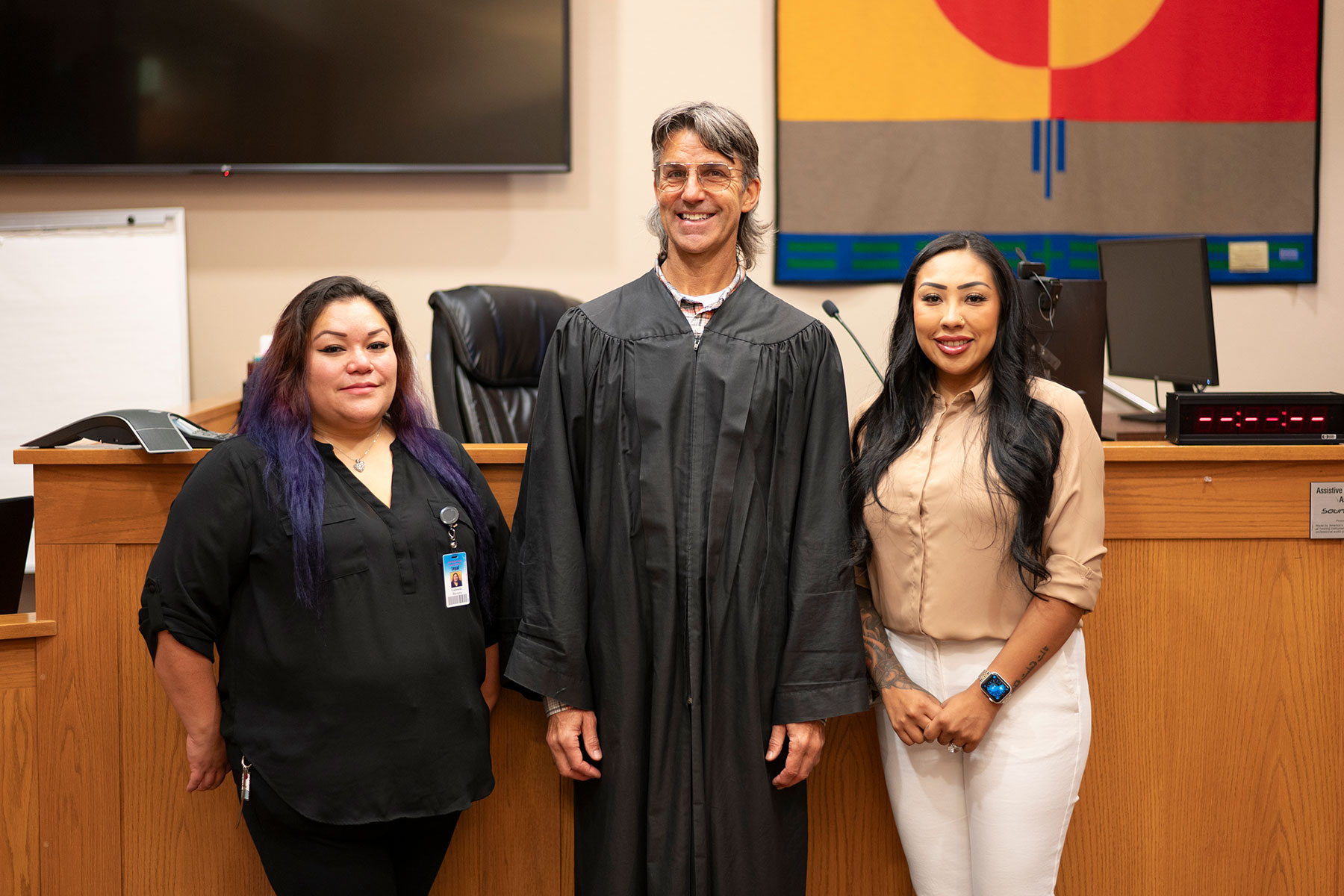
Gabby Herrera and Tasha Rodriguez have been working in the Legal Department as lay counselors after their swearing-in last year in August, working alongside Tribal Prosecutors and representing the Southern Ute Indian Tribe in criminal court cases. In this position, Herrera and Rodriguez hope to explore various matters within the Legal Department, attend law school, and work to assist youth.
Tasha Rodriguez is a Southern Ute tribal member, and she has been working as a paralegal for nine years. Before that, she worked in the Southern Ute Tribal Court as a court clerk and briefly worked with dispatch. Gabby Herrera is also a Southern Ute tribal member and has been working as a legal assistant for the Legal Department since 2021 following her graduation from Fort Lewis College.
A lay counselor or a lay advocate is a person who is a non-lawyer and who is qualified by the Court to represent a party in a court case. Lay counselors are held to the same standards and are entitled to the same rights, privileges, obligations, and duties as an attorney admitted to practice before court. Job qualifications include eligibility to practice as a lay counselor in Tribal Court, general knowledge of tribal jurisdiction and Indian law, experience as a legal secretary, court clerk or paralegal, and have a Bachelor of Arts in law enforcement, criminal justice, or related studies.
“My role as a lay counselor is to work with the tribal prosecutor and represent the Southern Ute Indian Tribe, I have my own case load and work with various departments such as SUPD, probation, public defenders, and victim services to achieve resolution,” Herrera said. “As lay counselors, we also have the opportunity to work with other matters within the Legal Department that aren’t criminal, so we can expand our knowledge. I also perform various assistant duties such as drafting motions, compiling discovery for cases, reviewing discovery, interviewing witnesses, data entry, etc.”
This position has been challenging, but equally rewarding for the pair in their individual career paths, gaining firsthand experience in a law office and guidance from their peers helping them discover their passion in law.
“For me in five to ten years I want to continue working with the Tribe serving my tribal membership, with my lay advocate position I am leaning towards civil cases.” Rodriguez said. “Helping families and speaking on their behalf, working with juveniles is really big for me that is my passion–through these nine years I was able to work my way up and I feel like I have gained a lot of knowledge and experience.”
“This position has been very valuable to me in my career as I work towards my juris degree, the experience I am gaining in court and within the legal department has effectively provided me with the necessary tools needed to understand the content in law school.” Herrera said. “The attorneys here have guided me on how to apply for law school, where to find study materials, how to manage my time and have given me advice on what to expect–in five years I see myself as a lawyer, I would like to work for the Tribe or the State, eventually I would like become a United States Attorney and then a judge.”
Lay advocates are crucial in Indian Country as they close the legal representation gap that is needed in rural areas of reservations where there may not be enough attorneys available. Lay counselors or advocates are significant not only for membership representation, but also for tribes as sovereign nations.
“Being in court in front of the judge, opposing counsel, and defendants can be very intimidating, but having the prosecutor there to guide me helped ease my nerves,” Herrera said. “I have been in court for almost a year now and I still feel like I am learning new things every week.”
“With this lay counsel position, I hope this inspires people to think ‘I can do that.’”