

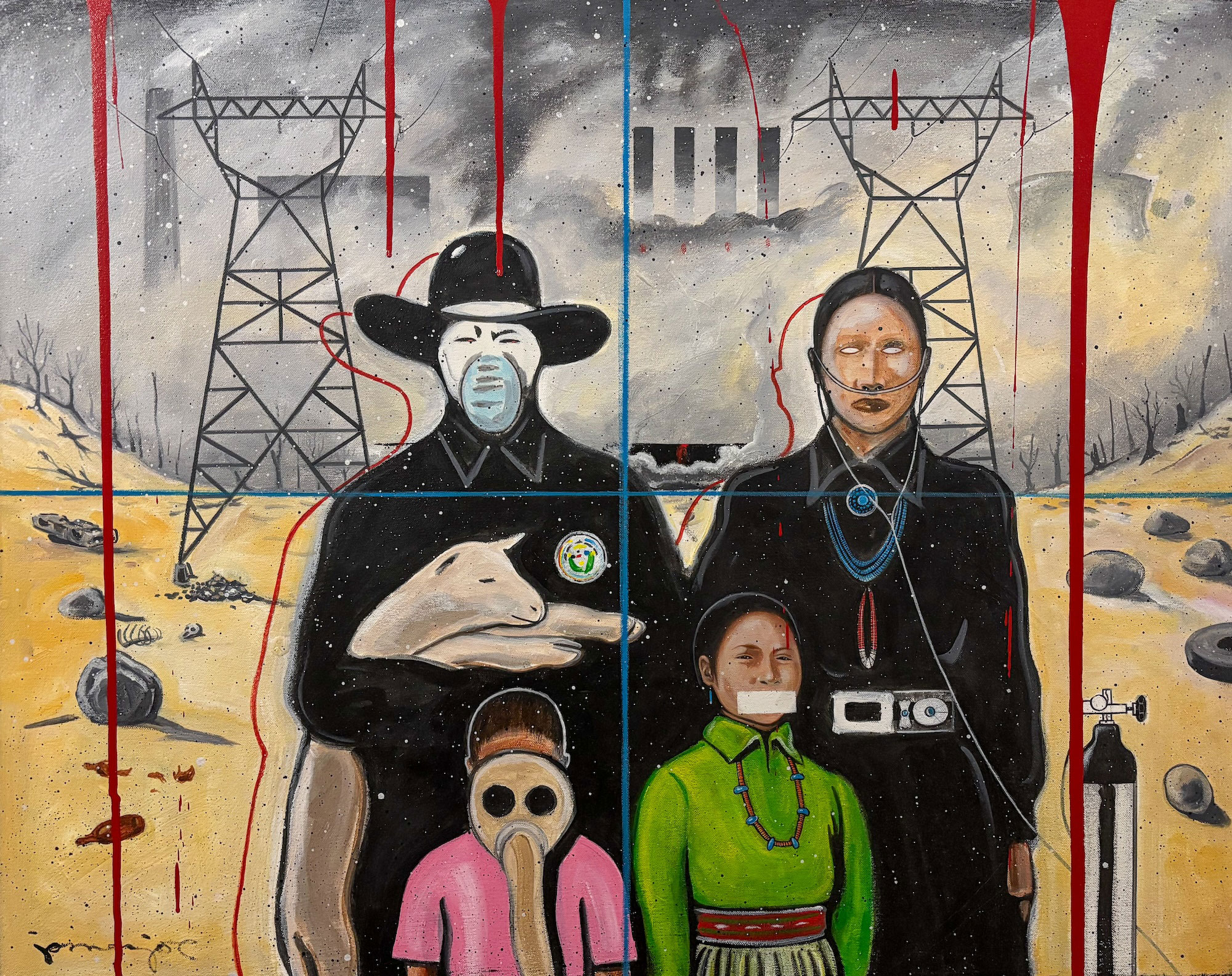
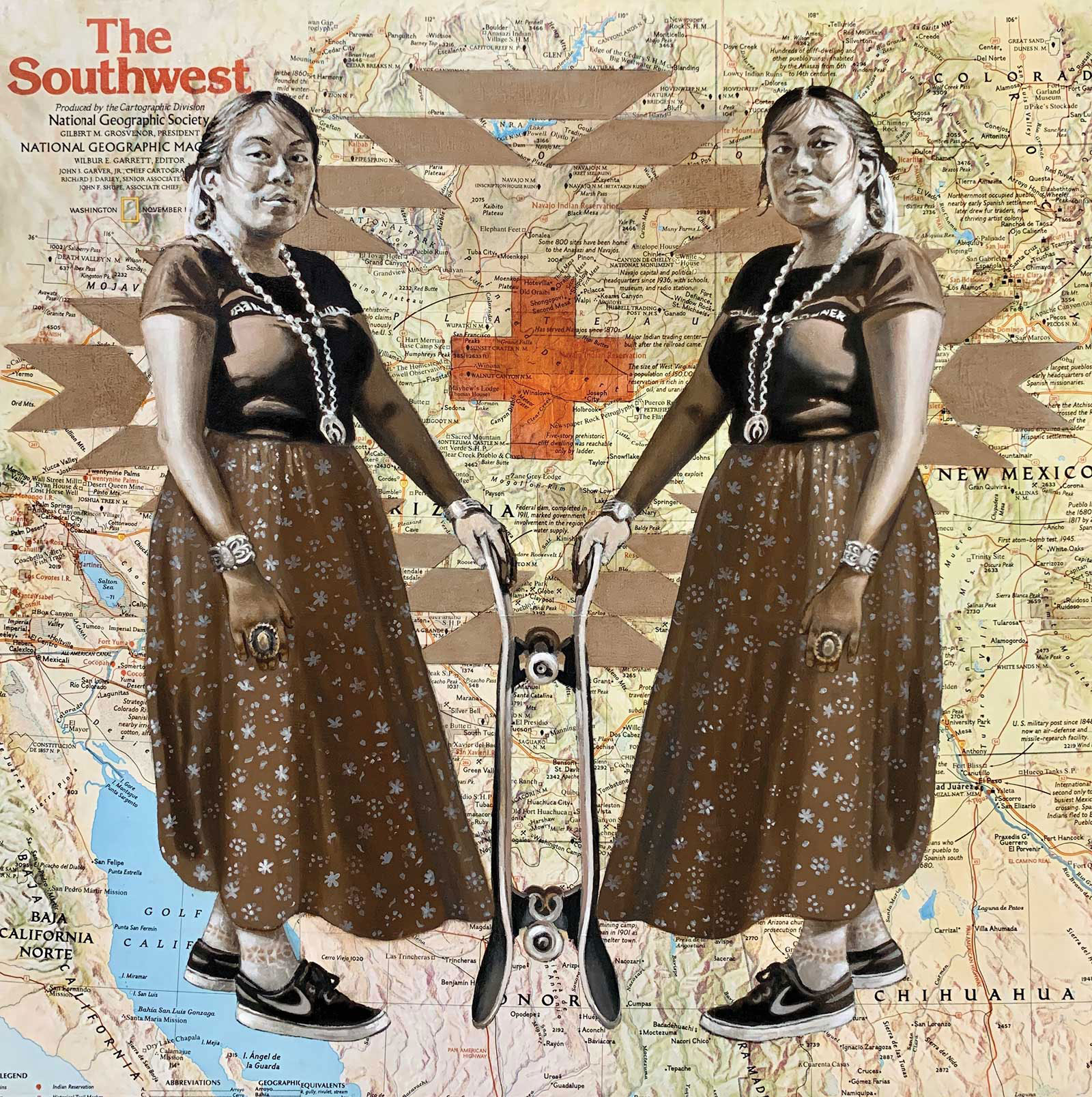
The Center of Southwest Studies at Fort Lewis College (FLC) is pleased to present Constellations of Place, a major exhibition rooted in the landscapes and layered histories of Southwest Colorado. Guest curated by scholar, writer, and independent curator Dr. Meranda Roberts (Yerington Paiute, Chicana), Constellations of Place will feature a selection of over 60 textiles, pottery, beadwork, 2D, and mixed media from the Center’s museum and archival collections alongside the work of 13 invited contemporary Native American, Indigenous, and Latinx artists.
Constellations of Place will open with a reception on Thursday, Jan. 15, 2026, from 4:30-6:30 p.m. featuring live music by Diné sound artist Kino Benally (DJ Béeso). The exhibition will be on display and freely accessible to the public through Dec. 18, 2026.
Constellations of Place is a collaborative project between the Center of Southwest Studies, Department of Reconciliation, and Four Corners Bridging Institute at Fort Lewis College, and the result of over a year of planning, listening sessions, and research. Constellations of Place is made possible with generous support from the Belonging Colorado initiative of The Denver Foundation and the Greater Good Science Center and is in partnership with the America 250-Colorado 150 Southwest regional “Power of Place” initiative.
Loaned works will span mediums of sculpture, screenprint, video projection, digital collage, painting, photography, beadwork, and textiles from invited artists:
- Solange Aguilar (Mescalero Apache, Yo’eme, Filipinx)
- Venancio Aragón (Diné, FLC alum)
- Linda Baker (Southern Ute, FLC alum)
- Karen Clarkson (Choctaw)
- Demian DinéYazhí (Diné)
- Jason Garcia (Tewa-Santa Clara Pueblo)
- Layli Long Soldier (Oglala Lakota)
- Charine Pilar Gonzales (Tewa-San Ildefonso Pueblo, FLC alum)
- Darby Raymond-Overstreet (Diné)
- Cara Romero (Chemehuevi)
- Tyrrell Tapaha (Diné)
- Vicente Telles (Latinx)
- José Villalobos (Latinx)
Exhibition Overview
Southwest Colorado holds stories in its mountains, rivers, and canyons – stories that long predate colonization. For generations, the Nuuchiu (Ute), Diné, Apache, Hopi, and Pueblo people lived in relation to this land, moving through networks of kinship, trade, and care.
In time, these routes were crossed and redirected by settler expansion. Trails became highways; rivers were renamed, and the region was romanticized as a land of beauty and freedom – narratives that erased both displacement and exploitation. Yet movement also carried memory: routes of return that endured even through separation and loss.
As Colorado marks 150 years of statehood and the United States approaches its 250th anniversary, Constellations of Place offers a different kind of reflection – not a celebration of milestones, but an invitation to look closely at how we understand place, memory, and belonging. The land itself is a witness – a record of kinship, endurance, and return.
Fort Lewis College sits at the heart of this story. Once a military outpost and later a federal Indian boarding school (1891–1911), it is now a public institution serving Indigenous, Native American, and Latinx students who continue to navigate that inheritance. Though its role has changed, its foundations remain shaped by histories of removal and assimilation – and by the perseverance, creativity, and love that endure.
Rather than presenting a linear story of progress, Constellations of Place gathers an interconnected field of artistic practices rooted in this region – works that hold space for grief and endurance, rupture and repair, beauty and burden. Drawn from the Center’s collections and from contemporary Indigenous, Native American, and Latinx artists, these works remind us that survival is not passive, but an active practice of creation, adaptation, and care.
Grounded in conversations with students, artists, and community members, the exhibition affirms that art is not merely a reflection of the past – it is a map, tracing lines of endurance and return, and offering routes toward truth-telling, shared responsibility, and collective imagination.
Visitors will be invited to move beyond reflection toward responsibility – to see how art can become a map for truth-telling, repair, and renewed belonging, and urge us to consider:
What does this place carry – and what have we been taught to forget?
What truths remain unspoken, unsettled, or obscured?
And how might we carry them – together – into a future that honors the beauty of this region, confronts its layered histories, and deepens our responsibility to one another and the land?
Constellations of Place also intentionally connects to the ongoing reconciliation and belonging efforts at Fort Lewis College, aiming to create a space where truth is spoken with care, where memory is held with accountability, and where the work of reconciliation is extended through art, story, and relation. Rather than treating reconciliation as a conclusion, this exhibition understands it as an ongoing responsibility – one that requires institutions, communities, and visitors alike to step into deeper forms of belonging.
About the Center of Southwest Studies
The Center of Southwest Studies shares the mission of Fort Lewis College to promote inclusive, experiential learning that fosters innovation, growth, and community engagement. As a museum, archives, and library dedicated to the diverse cultures, histories, and environments of the Southwest, the Center provides collections-based learning opportunities and internships for students, preserves and provides access to its research collections, and offers exhibits and educational programs for the College and the public.